
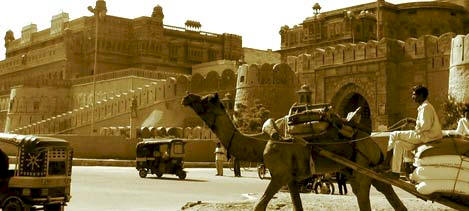
The History of Rajasthan
The Historical Rajasthan, The Land of the Kings, battle-scarred forts,
palaces of breathtaking grandeur and whimsical charm, riotous colors and even
its romantic sense of pride and honor.
The state is diagonally divided into the hilly and rugged south-eastern region
and the barren north-western That Desert, which extends across the border into
Pakistan. There are plenty of historic cities, incredible fortresses awash with
legends, and rare gems of impressionistic beauty, such as Udaipur. There are
also a number of centers that attract travelers from far and wide, such as
Pushkar with its holy lake, and the desert city of Jaisalmer, which resembles a
fantasy from "The Thousand & One Nights".
Rajasthan is one of India's prime tourist destinations. Nobody leaves here
without priceless memories.
Rajasthan was inhabited long before 2500 BC and the Indus Valley Civilisation
had its foundation here in north Rajasthan itself. The Bhil and the Mina tribes
were the earliest dwellers of this area.
Around 1400 BC the Aryans paid a visit and settled forever in the area. The
local population was pushed down south and towards the east. Afghans, Turks,
Persians and Mughals followed in mixing their blood, first in war then in peace,
with the existing original inhabitants. This blending gave the martial lineage
to the Rajputs.
From the times of Harsha (7 AD) to the founding of the Delhi Sultanate,
Rajasthan was fragmented in competing kingdoms. Perhaps it was during this era
by their influence through wealth and power the Rajputs persuaded the Brahmins
to link them with the sun, the moon and the fire god.
With the passage of time they were divided into 36 royal clans. Rajasthan
finally settled for a long and lasting reign under the colourful and vibrant
Rajputs. and it's a surprise that they lasted as long as they did. Considering
that they were at a constant state of aggression; if not with a foe, then with
each other. After the 14th century their influence declined in the area.
In came the Mughals who gained control of the region through the clever strategy
of Akbar, the Mughal Emperor. He performed matrimonial alliances with the
Rajputs where faced military failure and thus turned them from fearsome foes to
faithful friends. This proud but very divided race was thus brought to some
order under the imperial Mughals, by the some deft mixing of marital and martial
relations. Akbar gave high offices to many Rajput princes after seeking
reconciliation through marriage to a Rajput princess, Jodha Bai, the daughter of
the Maharaja of Amber. However, the spunk of the Rajput soul was never really
captured, till the spread of the British colonial power. However, when the
Mughals weakened they were quick to reassert their dominance. The Rajputs as a
community thus has outlived the somewhat tribal Delhi Sultanate, the grand
Mughals and the war-like Marathas. In fact to this day their descendants, though
stripped of their titles and kingdoms, are revered as rulers by the common man.
Rajasthan - History
Rajasthan is the home of the Rajputs, a group of warrior clans, who have
controlled this part of India for 1000 years according to a code of chivalry and
honor akin to that of the medieval European knights. While temporary alliances
and marriages of convenience were the order of the day, pride and independence
were always paramount. The Rajputs were therefore never able to present a united
front against a common aggressor. Indeed, much of their energy was spent
squabbling among themselves and the resultant weakness eventually led to their
becoming vassal states of the Mughal empire. Nevertheless, the Rajputs' bravery
and sense of honor were unparalleled.
Rajput warriors would fight against all odds and, when no hope was left,
chivalry demanded that jauhar (mass suicide) take place. In this grim ritual,
the women and children committed suicide by immolating themselves on a huge
funeral pyre, while the men donned saffron robes and rode out to confront the
enemy and certain death. In some of the larger battles, ten of thousands of
Rajput warriors lost their lives in this way. Three times in Chittorgarh's long
history, the women consigned themselves to the flames while the men rode out to
their martyrdom. The same tragic fate befell many other forts around the state.
It's hardly surprising that Akbar persuaded Rajputs to lead his army, nor that
subsequent Mughal emperors had such difficulty controlling this part of their
empire.
With the decline of the Mughal empire the Rajputs gradually clawed back their
independence through a series of spectacular victories, at least until the
British arrived. As the Raj inexorably expanded, most Rajput states signed
articles of alliance with the British, which allowed them to continue as
independent states, each with its own King, subject to certain political and
economic constraints.
These alliances proved to be the beginning of the end for the Rajput rulers.
Indulgence and extravagance soon replaced chivalry and honor so that by the
early 20th century, many of the maharajas spent much of their time traveling the
world with scores of concubines and retainers, playing polo, racing horses, and
occupying entire floors of the most expensive hotels in Europe and the USA.
While it suited the British to indulge them in this respect, their profligacy
was economically and socially detrimental. When India gained independence,
Rajasthan had one of the subcontinent's lowest rates of life expectancy and
literacy.
At Independence, India's ruling Congress Party was forced to make a deal with
the independent Rajput states in order to secure their agreement to join the new
India. The rulers were allowed to keep their titles, their property holdings
were secured and they were paid an annual stipend commensurate with their
status. It couldn't last forever, however, and in the early 1970s Indira Gandhi
abolished both the titles and the stipends and severely sequestered the rulers'
property rights.
While some of the rulers have survived this by converting their palaces into
luxury hotels, many have fallen by the wayside, unable to cope with the
financial and managerial demands of the late 20th centuary.
Once visit this state in your life and get the real experience of History,
Culture, Royalty and Romance.
Welcome Rajasthan Travel & Tourism Services
(Authorized by Tourism Dept. Govt. of Rajasthan)
C/O Umaid Mahal
,C-20 / B-2 Bihari Marg, Jai Singh Highway,
Opp. Lane of K.P. Automotives, Bani Park, Jaipur - 302016, Rajasthan (India)
Telephone : + 91-141-2205528 (09:00 A.M. To 06:00 P.M.)
+91-9829614748 (06:00 A.M. To 06:00 P.M.)
Fax : +91-141-2204470
For Car Rental Email: welcomerajasthan@yahoo.com
For Tour Package Email: info@welcomerajasthan.com
Emergency Contact Number : +91-9829614748




Other Information
City Distances Passport and Visa Information What to Pack Useful Phrases
Car Rental Services
Rajasthan Tour Packages
Tours from New Delhi
Rajasthan Historic tourMewari Tour with Agra
Classic Golden Triangle
Rajasthan Wildlife Safari
Rajasthan Real Adventure
Rajasthan Tour with Agra
Jaipur city tour w/ Pushkar
Rajasthan Desert tour
Classic Desert tour
Jaipur city tour
All tours starting from New Delhi
All tours starting from Jaisalmer