
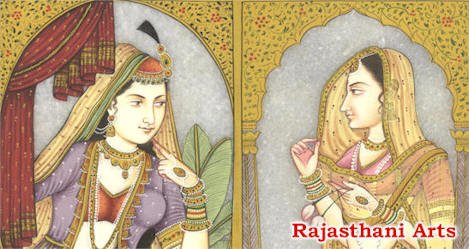
Arts and Crafts of Rajasthan
Rajasthan is among the richest states in the country as far as the field of
arts and crafts is concerned. May be it was a result of the war-like lifestyle
of the people of Rajasthan which sharpened the creative senses, artistic skills
and inspired them to create the most opulent and richest of treasures. Stone,
clay, leather, wood, ivory, lac, glass, brass, silver, gold and textiles were
given the most brilliant forms.
Art flourished in this region as far back as 2nd-1st centuries BC and continued
over the centuries. In Baroli, in the Hadoti region, presence of several
sculptures proves that a regular art school existed in the 10th century. The
cave paintings, terracotta and other stone sculptures excavated at different
sites corroborate this.
Each period of history saw its own contribution to the thriving art scene.
History of Rajasthan reveals that the kings and their nobles were patrons of
arts and crafts and they encouraged their craftsmen in activities ranging from
wood and marble carving to weaving, pottery and painting. And art seems to have
been an obsessed with the
inhabitants of this parched landscape. The desire to decorate their surroundings
was very strong. Nothing was overlooked animals from the regal elephant to the
lowly donkey, the great palaces and the inner chambers of forbidding forts were
decorated with as much attention as were the walls of humble mud huts. The
inhabitants were not too far behind when it came to adorning themselves and it
was not only the women who beautified themselves the heroic warriors extended
equal attention to their clothing and armour they went into battles with
meticulously ornamented swords and shields. The horses and elephants that took
the warriors to battles received the same care jewelled saddles and intricate
silver howdas were just some of the ornaments that were used to adorn them.
For women there was infinite variety tie and dye fabrics, embroidered garments,
enamel jewellery inlayed with precious and semi-precious stones, leather jootis.
They put their lives indoors to very good use by decorating their surroundings
on the walls of their mud-huts were painted geometric designs as well as simple
m s like flowers and birds. Also tile women folk made intricate patterns Out
doors shaped straw and twine to turn into the most beautiful items.
When the Rajputs came to dominate this region, it was a period of constant
strife. They were almost always in battle with their neighbouring kingdoms When
a kingdom fell and a new ruler took over, it was time for change paintings
depicting the new rulers victory, scenes from the battle and processions of the
victorious march were faithfully reproduced on the walls and handmade paper.
Other than the paintings, the new rulers also influenced the existing crafts of
that area. Despite their love for the battlefield, the Rajputs have been patrons
of art and also their 350 years of contact with the Mughals led to a very strong
influence on their lives and arts. Quite a few folk arts received the refinement
and delicacy of the Mughal courts. They borrowed freely from the Agra and Delhi
courts and in some cases, also sent their skilled craftsmen to adorn the Mughal
courts.
Jaipur meenakari is famed for its delicacy and its use of colours. Pratapgarh
and Nathdwara are two other centres which produce fine quality enamel
work.
Jewelery
Rajasthan is rich in jewellery, each area having its own unique style. Some of the traditional designs are rakhri, tirnaniyan, bala, bajuband, gajra, gokhru, jod, etc. Tribal women wear heavy, simply crafted jewellery and seem to carry the weight (almost up to five kgs) without much discomfort almost all the time. Men too wear their share of ornaments in the form of chockers and earrings.
Ivory
The ivory bangles that most Rajasthani women wear are considered auspicious. Ivory is also inlaid and shaped into intricate items of great beauty. Miniature paintings were also executed on ivory.
Lac and Glass
Lac bangles are made in bright colours and sometimes inlaid with glass. Other decorative and functional items are also available.
Sandalwood and Wood
Carved wood is presented in a wide range of objects and is simple and inexpensive.
Stone
Statues on religious themes are carved all over Rajasthan and in several cities there are still entire lanes where the stone carvers can be seen giving final touches to statues or even pillars. Other crafts like blue pottery, hand block printing, tie and dye, terracotta sculptures, painting on camel hide, embroidery, cloth painting, carpets, durries, inlay work on brass and wood are to be found all over Rajasthan.
Welcome Rajasthan Travel & Tourism Services
(Authorized by Tourism Dept. Govt. of Rajasthan)
C/O Umaid Mahal
,C-20 / B-2 Bihari Marg, Jai Singh Highway,
Opp. Lane of K.P. Automotives, Bani Park, Jaipur - 302016, Rajasthan (India)
Telephone : + 91-141-2205528 / 4914416 (09:00 A.M. To 06:00 P.M.)
+91-9829614748 (06:00 A.M. To 06:00 P.M.)
Fax : +91-141-2204470
For Car Rental Email: welcomerajasthan@yahoo.com
For Tour Package Email: info@welcomerajasthan.com
Emergency Contact Number : +91-9829614748




Other Information
City Distances Passport and Visa Information What to Pack Useful Phrases
Car Rental Services
Rajasthan Tour Packages
Tours from New Delhi
Rajasthan Historic tourMewari Tour with Agra
Classic Golden Triangle
Rajasthan Wildlife Safari
Rajasthan Real Adventure
Rajasthan Tour with Agra
Jaipur city tour w/ Pushkar
Rajasthan Desert tour
Classic Desert tour
Jaipur city tour
All tours starting from New Delhi
All tours starting from Jaisalmer